Author: Ramsha Sadiq Khan

  • Business Process Automation Services: What Buyers Actually Get vs. What They Need

    Business Process Automation Services: What Buyers Actually Get vs. What They Need

    Here is the version of the story that gets told to buyers.

    You invest in business process automation services. A vendor comes in, assesses your workflows, recommends a platform, configures it, and hands it over. Your manual work disappears. Your reports build themselves. Approvals stop stalling. The operation runs on its own.

    Here is what actually happens in most companies.

    A platform gets licensed after a lengthy evaluation. Implementation runs longer than projected. The demo configuration breaks against real data. A few processes work reasonably well. Several never get finished. Maintenance turns out to cost more than anyone planned. Two years later, the manual work that prompted the initiative is still happening by the same people, in the same way, except now there is an automation platform to maintain on top of it.

    This is not a vendor failure. It is a buyer failure: a failure of what buyers ask for versus what they actually need. And it is the most expensive pattern in mid-market operations today.

    The short answer: Fewer than 6% of organizations have achieved autonomous automation in any core business process, despite rising investment and near-universal belief that automation is mission-critical. The money is going in. The results are not coming out. Understanding why starts with understanding what BPA services actually are, what they are sold as, and where the two diverge.


    What BPA services actually are

    Business process automation (BPA) is the use of technology to run an end-to-end business process without a human executing each step manually. Not a single task. An entire workflow: the trigger that starts it, the logic that routes it, the systems it touches, the escalations it triggers, and the output it produces.

    BPA vs. RPA vs. IPA: what each one does

    TermWhat it automatesScopeBest for
    RPA (Robotic Process Automation)Individual repetitive tasks at the screen levelTaskDiscrete, rule-based actions in legacy systems
    BPA (Business Process Automation)End-to-end workflows, including routing, decisions, and handoffsProcessMulti-step, cross-system workflows that need redesign
    IPA (Intelligent Process Automation)Unstructured inputs, contextual decisions, continuous improvementProcess + AIComplex workflows requiring judgment and adaptation

    The distinction matters because an RPA deployment that automates individual tasks without fixing the process around them produces something that looks like automation and costs like automation but delivers none of the operational change that was the point.

    Three sourced realities about RPA failure:


    What the BPA services market sells

    The global BPA market was valued at approximately $15 billion in 2024 and is projected to double by the end of the decade. A significant share of that spend buys the following, in order of how commonly it is packaged and sold.

    The standard BPA vendor stack

    What gets soldWhat it actually deliversWhat it doesn’t include
    Platform licenseSoftware capability, inert until configuredNone of the work to make it useful
    Process assessment and roadmapA prioritized plan for what to automateThe automation itself
    Implementation and configurationWorking automations in controlled conditionsGuaranteed production performance
    Training and change managementTeam knowledge of the new workflowOften the first item cut when budgets tighten
    Support retainerBreak-fix when something failsProactive maintenance, outcome accountability

    Notice what is absent from every row. There is no line item for an accountable owner responsible for the business outcome. There is no mechanism that ties the vendor’s success to your operational result. The market sells platform, configuration, and break-fix. Buyers need outcome ownership.


    The four places the gap opens

    Between what gets sold and what gets needed, four predictable gaps open in nearly every enterprise automation engagement that stalls.

    Gap 1: The process gets automated before it gets fixed

    The single most common reason automation fails to deliver is that the process being automated was broken before the automation started, and nobody redesigned it.

    A broken process, automated, is a broken process that runs faster and at scale. The manual workarounds that were holding it together get stripped out by the automation, and the underlying dysfunction surfaces as exceptions the system cannot handle.

    BPA’s definition includes process models and related business, decision, and data models as native components for exactly this reason. Process modeling before automation surfaces broken logic before it gets encoded. In practice, that step gets compressed or skipped when timelines are tight, and the platform is already licensed.

    Gap 2: Data lives in systems that don’t talk

    Most valuable business processes span multiple systems: a CRM, an ERP, a project management tool, a spreadsheet, and a shared inbox. Real BPA connects these at the system level. The problem is that many mid-market companies have systems that were never designed to connect, and the integration work required is both technically complex and significantly underestimated in scope.

    The scale of this problem in numbers:

    The platform license does not solve the integration problem. Someone competent has to solve it, and then someone has to keep it solved.

    Gap 3: Nobody owns the outcome after go-live

    This is the gap that kills more automation value than any other. The project team ships, the engagement closes, the support contract activates, and the result is left to maintain itself.

    But automation systems are not static. When an upstream system updates its API, when a compliance rule changes, when a process owner adds a new exception type, the automation breaks or silently produces wrong outputs. Without someone watching it, drift is invisible until a problem surfaces, often weeks or months later.

    Two numbers that confirm this is the norm:

    That is not a technology problem. It is a maintenance and ownership problem, and neither a platform license nor a standard support retainer solves it.

    Gap 4: The wrong process got automated

    When an organization buys BPA services without a clear, dollar-denominated view of where the most expensive manual work actually lives, automation budget flows to the most visible processes rather than the most costly ones.

    The customer-facing chatbot gets built. The monthly reconciliation eating eighty hours continues by hand. The approval workflow slowing deal velocity every week never gets touched.

    The result: automation activity (things run automatically) with no measurable return (margin didn’t move). You can prove the bot is running. You cannot prove the business is better.


    What buyers actually need from BPA services

    The gap is not a reason to avoid automation. It is a reason to buy it differently. Here are the five things organizations that consistently see measurable returns get right, and that standard vendor offerings rarely package together.

    1. A cost-first entry point, not a technology-first one

    Before a platform gets selected, before a process gets mapped, the question is: where is the most expensive manual work, in dollars, right now?

    A four-hour weekly process that spans five people is more than a month of one person’s annual output. Multiplied across a dozen such processes, it is the missing margin. The organizations that see real returns from workflow automation services start by putting a number on the problem, then building at the number.

    2. Process redesign before automation

    The automation should be built around the process as it should work, not the process as it currently limps along. This requires someone with enough operational understanding to:

    • Distinguish a broken step from a necessary one
    • Identify where manual work is a symptom of an upstream problem
    • Redesign the workflow before encoding it into a system

    Compressing this step transfers the cost to post-launch, where fixing a broken automation is far more expensive than fixing a broken process before it is automated.

    3. Integration that treats your data as the asset

    Real enterprise workflow automation connects to the systems where the data actually lives: the CRM, the ERP, the databases, the tools that hold the inputs the process needs. It also means keeping all of that data on your own infrastructure, under your own security policy. Not passing it through a vendor’s stack.

    4. One accountable owner, not a ticket queue

    The difference between an automation that holds and one that decays is the presence of someone who owns the outcome, not just the delivery. That person needs to:

    • Watch the system after go-live and catch drift before it adds up
    • Re-integrate when upstream systems change
    • Stay accountable for the business result, not just the delivery date

    This is the role of an AI Orchestrator: not a bot manager or a support ticket processor, but an embedded operator who treats the automation as a living system and the operational result as their responsibility.

    A financial-services firm whose compliance staff spent hours every day fielding routine questions from newer employees built a searchable knowledge system that now resolves around 80% of those questions without senior involvement: an estimated $900K in value in the first year. A food-benefits platform whose support volume was outpacing headcount automated its highest-volume workflows through an AI voice line, avoided five planned hires, and created an estimated $375K in year-one value. In both cases, an AI Orchestrator went in, found the costliest manual work, put a real number on it, and built the system that removed it.

    5. Scope that starts with one problem, not a transformation

    The most reliable path to measurable automation return is the narrowest one:

    • One named process
    • A defined timeline
    • Agreed acceptance criteria
    • A dollar figure you believe
    • One person accountable for it

    Prove it. Then move to the next. Organizations that try to automate everything at once produce the fewer than 6% Redwood’s research identifies: automation investment without autonomous automation in any core process.


    RPA vs. BPA: choosing the right tool for the right problem

    Most mature automation programs use both. The entry point is what matters.

    QuestionIf yes, start with…
    Is the task a single, discrete action a human performs at a screen?RPA
    Does the task span multiple systems, teams, and routing decisions?BPA
    Does the workflow involve unstructured inputs or contextual decisions?IPA
    Have you already deployed RPA but hit a ceiling on value?BPA (process redesign first)

    RPA delivers rapid results and deploys quickly: simple automations can be done in days or weeks. It is ideal when legacy systems dominate and quick wins are needed to build momentum. BPA projects typically require several months for process analysis, redesign, development, and testing, but the resulting solutions are more comprehensive and sustainable.

    The mistake is not choosing the wrong tool. It is choosing a tool before choosing a problem.


    What this means if you are buying automation services now

    If you are evaluating BPA services, the question to ask every vendor is not “what does the platform do?” It is: “who owns the outcome after go-live, and how is their success measured?”

    If the answer is a support SLA and a renewal conversation, you are buying a tool. If the answer is a person attached to your operation, accountable for a result you defined together, you are buying an outcome.

    The BPA market is large, well-funded, and genuinely useful. The platforms work. The technology is not the problem. The problem is that the market has built a very efficient machine for selling capability, and most buyers have not yet learned to ask for accountability instead.

    The organizations that have, the ones making up the fewer than 6% with genuine autonomous automation in their core processes, started at the same place: they found the most expensive manual work, put a real number on it, assigned one accountable owner to remove it, and built a system around the specific problem rather than the generic capability.

    The platform was the last decision, not the first. That order of operations is available to any organization willing to ask for it.

    If you want to understand what that looks like in practice, see how an AI Orchestrator approaches the diagnostic.


    Creative Chaos embeds an AI Orchestrator inside your operation to find the costliest manual work, put a dollar figure on it, and build the system that removes it. On your own systems, with one person accountable for the result. The diagnostic takes two to three hours, and ends with a number you believe, not a platform recommendation. Book a diagnostic.


    Common Questions

    What are business process automation services and what do they typically include?

    Business process automation services help organizations replace manual, repetitive workflows with automated systems. A standard offering includes a process assessment, platform selection, configuration, team training, and a post-launch support contract. What is less commonly included, but most consequential for results, is an accountable owner who stays responsible for the operational outcome after the system goes live.

    What is the difference between RPA and BPA?

    RPA automates individual, repetitive tasks at the screen level: a bot mimics what a human does with a keyboard. BPA automates entire end-to-end workflows: the routing, the decisions, the system integrations, the handoffs, and the exceptions across a full process. RPA is a component inside a larger process automation strategy. BPA is the architecture. Confusing the two typically results in bots that automate individual steps without fixing the handoffs around them.

    What is intelligent process automation and how does it differ from BPA?

    Intelligent process automation combines BPA with AI, machine learning, and natural language processing to handle processes involving unstructured inputs, contextual decisions, or continuous improvement. Standard BPA handles structured, rule-based workflows. IPA extends that to document processing, email classification, exception routing, and workflows that need to adapt over time. The IPA market is projected to grow from $14.55 billion in 2024 to $44.74 billion by 2030.

    Why do so many business process automation projects fail to deliver ROI?

    Four gaps account for most failures: the process gets automated before it gets redesigned, so broken logic runs at scale; data lives in disconnected systems the automation cannot bridge; nobody owns the outcome after go-live, so drift goes unnoticed; and the wrong process got automated because budget followed visibility rather than cost. Each gap is preventable, but preventing them requires an engagement structure most vendors do not offer by default.

    How should we approach buying BPA services to actually get results?

    Start with a cost-first question: where is our most expensive manual work, in dollars, right now? Redesign the process before encoding it. Choose the platform last, after the problem is defined. Demand one accountable owner whose success is measured by the operational result, not the delivery date. Scope one problem at a time, prove it, then move to the next. The organizations reaching genuine automation follow that sequence; the ones that don’t start with the platform.

  • Best AI Automation Services: What the Lists Get Wrong

    Best AI Automation Services: What the Lists Get Wrong

    Search “best AI automation services,” and you will get pages of lists. Zapier. Make. n8n. UiPath. LangChain. Ten tools, ranked by features and pricing tiers.

    Here is the problem. You were not looking for software. You were looking for someone to hire.

    If you are a CEO, COO, or Managing Director at a 15- to 250-person company, you have probably already bought the tools on those lists. Your team has ChatGPT subscriptions. Someone set up a Zapier account. Maybe an agency built you a chatbot. And your operation runs exactly the way it did before.

    The list answers the question “what software automates tasks.” Buyers are asking, “Who will make AI actually work inside my business?” Those are different questions. This article answers the second one: what the lists leave out, how to evaluate an actual AI automation service, what results to demand, and what it should cost.

    The Short Answer

    The best AI automation service is not a software platform. It is a person or firm that maps your operation, quantifies what manual work is costing you in dollars, builds the system that recovers that money, and stays accountable for a measurable outcome. Software is an ingredient in that process, not a substitute for it. Everything below explains how to tell the difference and what to look for.

    What the “Best AI Automation Services” Lists Actually Rank

    Look closely at the top-ranking content for this search term and three formats repeat:

    Tool roundups.

    “15 Best AI Automation Tools in 2026.” These rank software platforms by features, integrations, and pricing tiers. Useful if you have an in-house team ready to build. Useless if you do not, because a platform license does not map your processes or ship anything.

    Agency directories.

    Pay-to-play listings ranked by review volume, not results. These agencies sell deliverables: a chatbot, a workflow, a proof of concept. What they rarely sell is a dollar figure they are accountable for.

    Body-shop comparisons.

    Lists of firms renting developers by the hour. You get capacity. You do not get someone who decides what is worth building in the first place.

    All three formats share the same blind spot. They rank inputs: tools, hours, and deliverables. None of them rank the only output that matters, which is verified business value. That is not an accident. Input-based content is easy to produce and easy to monetize with affiliate links. It just does not solve your problem.

    Best AI Automation Services: What the Lists Get Wrong

    Why the Lists Fail You: AI Has an Execution Problem

    The gap between buying AI and benefiting from AI is now one of the best-documented findings in enterprise technology.

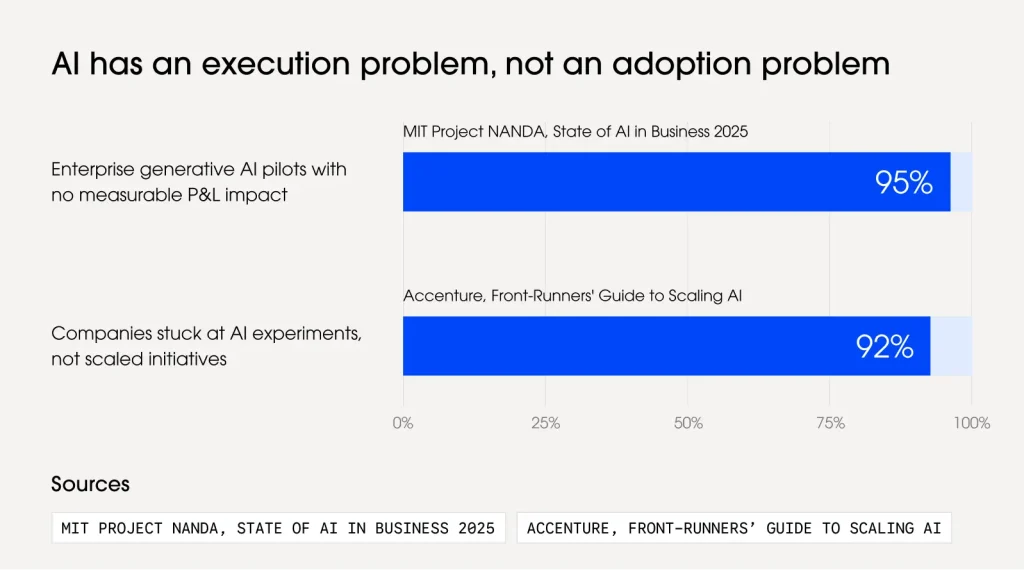
    MIT’s Project NANDA found in its State of AI in Business 2025 report that 95% of enterprise generative AI pilots deliver no measurable impact on profit and loss, despite an estimated $30 to 40 billion in enterprise spend. The lead author’s diagnosis was not model quality. Tools stall in enterprise use because they do not adapt to how the business actually works, and nobody owns the path from pilot to production.

    The same MIT research surfaced a second finding that should change how you buy: more than half of generative AI budgets go to sales and marketing tools, yet the biggest measured ROI came from back-office automation. Companies are spending where AI is most visible, not where it is most valuable.

    Accenture’s findings point in the same direction. Its Front-Runners’ Guide to Scaling AI, based on a survey of 2,000 C-suite and data science executives, found that only 8% of companies have successfully scaled strategic AI initiatives across their operations. The other 92% remain stuck at experiments.

    Best AI Automation Services: What the Lists Get Wrong

    Read those numbers together, and the conclusion is hard to avoid. Most companies do not have an AI adoption problem. They have an implementation problem. Another platform subscription cannot fix it, because the missing piece is not software. It is a person with the judgment to find the right problem, the skill to build the fix, and the accountability to stay until it produces a number you can verify.

    Software vs. Services: What You Are Actually Buying

    DimensionAI automation softwareA real AI automation service
    What you getA platform licenseA working system in production
    Who maps your processesYouThey do
    Who builds and integratesYour team or a contractorThe same person who did the diagnosis
    Who maintains itYouThey do, optionally, with notice to stop
    Pricing basisPer seat, per task, per monthShould be tied to outcome value
    AccountabilityNone beyond uptimeA dollar figure agreed before the build
    When it failsYou troubleshootThey are on the hook

    If a provider on any “best of” list cannot place itself cleanly in the right-hand column, it is selling software or hours wearing a services costume.

    How to Evaluate an AI Automation Service: The Five Tests

    1. They start with your operation, not their technology.

    Most vendors begin with the tool they sell and look for places to apply it. The right partner begins with how work moves through your business: where time is wasted, where handoffs break, and which manual processes cost the most. The workflow determines the answer. Not the tool.

    2. They implement, not advise.

    You have probably seen the strategy deck before. Recommendations, a roadmap, an invoice, and then nothing. The deliverable should be working software running inside your operation, not a PDF describing software someone else might build later.

    3. They quantify the value before the build.

    If a provider cannot tell you what an automation is worth in dollars before building it, they are guessing. Every engagement should start with a number you both agree on, built from your own operational data.

    4. You own everything.

    Every line of code, every workflow, every deployment should live in your accounts and your repositories from day one. If walking away from the vendor would break your systems, you did not buy automation. You bought dependency.

    5. One person is accountable for the outcome.

    Not a rotating delivery team. Not an account manager relaying messages between you and developers you never meet. The person who diagnosed the problem should be the person who builds the system and is responsible for the result.

    Run any vendor through those five tests. Most fail the first two.

    Best AI Automation Services: What the Lists Get Wrong

    What Is an AI Orchestrator?

    An AI Orchestrator is a senior practitioner embedded inside a business who identifies where money is being lost to inefficient manual work, oversees the implementation of systems that recover it, and stays accountable for measurable outcomes.

    It is the role AI created. Before AI, automating a business process required a business analyst to map it, an architect to design the system, engineers to build it, and a DevOps team to run it. AI compressed that stack. One person with the right judgment now spans all four:

    Part business analyst.

    Maps how your team actually works and where the highest-cost friction sits.

    Part architect.

    Designs how systems connect, where AI agents fit, and what the data flow looks like.

    Part engineer.

    Builds and ships. AI writes much of the code; the Orchestrator governs what AI produces, reviewing, validating, and deploying to production standards.

    Part DevOps.

    Owns monitoring, alerting, and incident response. The person who built the workflow is the same person watching it run.

    An AI Orchestrator is not a consultant. Consultants diagnose and hand over a deck; an Orchestrator implements. It is not a traditional engineer either. Engineers wait to be told what to build; an Orchestrator walks in and says: I have mapped your process, here is what AI should handle, and I will build it and get it running.

    Notice that this role passes all five tests above by definition. That is not a coincidence. The tests describe the job.

    What Results Should an AI Automation Service Produce?

    Specific dollar figures, set with the client. Not “efficiency gains.” 

    Here are two examples from Creative Chaos engagements:

    A US-based financial services company

    Depended on senior staff to answer questions from customer service, operations, and new hires, pulling experienced people away from higher-value work. The bottleneck was knowledge transfer. Documentation scattered across multiple data sources was consolidated into a RAG-based searchable knowledge base. Today, 80% of operational queries are resolved without senior team involvement. Year-one value: $900K, set with the client.

    A US-based food benefits platform

    was watching member volume grow faster than its support team could absorb. Hiring looked inevitable. The highest-volume support workflows were automated through an AI voice helpline integrated with the client’s internal systems. The business avoided five new hires, automated 13 member-support workflows, and created an estimated $375K in year-one value.

    Best AI Automation Services: What the Lists Get Wrong

    If a provider cannot show you outcomes in this format, a sector, a mechanism, and a dollar figure, you are looking at a tool reseller, not an implementation partner.

    How Much Do AI Automation Services Cost?

    Most providers will not tell you until you are three calls deep. Here is the Creative Chaos model, published:

    It starts with a diagnostic.

    Two to three hours. An AI Orchestrator maps your highest-cost manual process, builds the dollar figure with you, and gives a straight answer on whether a build is worth doing.

    The build is priced at a percentage of the year-1 outcome value

    The build is priced as a percentage of the year-one outcome value, calculated together during the diagnostic.

    The economics come before the technology. If the opportunity is not worth pursuing, no one builds anything.

    Common Questions

    What is the difference between AI automation software and AI automation services?

    Software is the platform: tools like Zapier, n8n, or LangChain that execute automated workflows. Services are the people who decide what to automate, build it, integrate it with your existing systems, and keep it running. Most “best AI automation services” lists rank the software and skip the services entirely.

    What is the difference between an AI consultant and an AI Orchestrator?

    A consultant analyzes your business and delivers recommendations. An AI Orchestrator delivers working systems. The same person who identifies the opportunity builds the implementation and stays accountable for the measured outcome. No handoffs, no strategy decks without execution.

    How much does an AI Orchestrator engagement cost?

    It starts with a diagnostic to quantify the opportunity. If the build is worth pursuing, we agree on a fixed fee based on the estimated value, scope, and complexity before work begins. There are no hourly rates or surprise charges.

    We already bought AI tools and nothing changed. Why would this be different?

    Because tools were never the missing piece. MIT’s 2025 research found 95% of generative AI pilots show no measurable business impact, and the cause is implementation, not model quality. An AI Orchestrator starts from your operation, builds the business case in dollars, ships the system into production, and is measured against the number you set together.

    Do we keep the code if we stop working with you?

    Yes. Every line of code, workflow, and deployment lives in your repositories and accounts from day one. Walk away anytime, and everything keeps working.

    The Bottom Line

    The “best AI automation services” lists rank ingredients and call it a meal. If you have already bought the tools and your operation has not changed, the next purchase should not be another platform. It should be the person who makes AI actually execute inside your business.

    Find out what your operation is losing. Book a Diagnostic. It takes two to three hours and ends with a dollar figure and a straight answer.

  • Top AI Integration Companies for Mid-Market Businesses

    Top AI Integration Companies for Mid-Market Businesses

    The enterprise AI integration firms (Accenture, Cognizant, the Big Four) are built for Fortune 500 procurement cycles and seven-figure programs. The offshore dev shops at the other end will quote you an hourly rate before they understand your business. And the listicles ranking them are almost all written by the vendors themselves, including this one. The difference is that we will tell you that upfront, and we will give you honest entries for our competitors.

    This guide covers the AI integration companies worth evaluating if you are a mid-market buyer, what separates a real implementation partner from a body shop, and the questions that expose the difference in one call.

    The Short Answer

    The best AI integration company for a mid-market business is one that starts with your operation instead of its technology, delivers working systems instead of recommendations, prices against an outcome instead of hours, and leaves you owning every line of code. Most firms ranking for this search term fail at least two of those four tests. The list below tells you which firms fit which situation, because the honest answer is that the right partner depends on what you are buying.

    Top AI Integration Companies for Mid-Market Businesses

    How We Evaluated These Companies

    Full disclosure: Creative Chaos publishes this list and appears on it. So does every other list ranking for this keyword; RTS Labs, Addepto, Codewave, and Kodexo Labs all rank their own pages. What we can offer instead of false neutrality is a clear set of criteria you can apply to anyone, including us:

    Mid-market fit. Does the firm take engagements from companies without enterprise procurement teams, or does it quietly require Fortune 500 scale?

    Implementation over advice. Is the deliverable working software in production, or a strategy document?

    Outcome accountability. Is there a dollar figure the firm answers to, or just hours logged and tickets closed?

    Ownership. Does the code live in your repositories from day one, or does walking away break everything?

    Pricing transparency. Can you find out what it costs before the third sales call?

    The Companies

    1. Creative Chaos: Best for Outcome-Accountable AI Implementation

    Creative Chaos embeds AI Orchestrators inside mid-market businesses. An AI Orchestrator is a senior practitioner who maps where your operation is losing money to manual work, builds the systems that recover it, and stays accountable for a measurable outcome: part business analyst, part architect, part engineer, part DevOps, one person owning the path from diagnosis to production.

    The model is deliberately different from everyone else on this list:

    • Entry point: A two- to three-hour diagnostic. You get a mapped process, a dollar figure built from your own operational data, and a straight answer on whether a build is worth doing.
    • Pricing: A percentage of the year-one outcome value, calculated together during the diagnostic and agreed before work starts. No hourly rates.
    • Ownership: Every line of code, workflow, and deployment lives in your accounts from day one.
    • Track record: Founded in 2000, roughly 150 engineers, 100+ production launches, with delivery history for McDonald’s, Amazon, Coca-Cola, Qlik, and Emaar.

    Recent outcomes: a US financial services company now resolves 80% of operational queries without senior staff involvement after Creative Chaos consolidated scattered documentation into a RAG-based knowledge base (~$900K year-one value, set with the client). A US food benefits platform avoided five hires and automated 13 member-support workflows through an AI voice helpline (~$375K year-one value).

    For software product companies whose roadmap needs AI-native engineering, Creative Chaos also embeds Forward Deployed Engineers: the role Palantir made famous and OpenAI, Google, and Anthropic now run programs around, except those programs serve Fortune 500 exclusively, and Creative Chaos serves the mid-market.

    Best for: CEOs, COOs, and CTOs at 15- to 250-person companies who have bought AI tools, seen nothing change, and want a partner accountable for a number rather than a timesheet.

    2. Tribe AI: Best for Flexible Access to Frontier-Lab Talent

    Tribe AI is the closest thing to a direct competitor for the embedded-delivery model, and any buyer doing real homework will have seen them, so it is worth being precise about the difference. Tribe is a VC-backed AI talent network: a vetted community of 600+ engineers and product builders, many from OpenAI, Google, Meta, and NVIDIA, that the company assembles into project teams with a Tribe delivery lead. It is founding partners with OpenAI and Anthropic, and in 2026, it acquired a recruiting firm to scale its Forward Deployed Engineer bench.

    The distinction that matters for a mid-market buyer is the model. Tribe is staffing-led: you bring the problem, Tribe matches you to fractional practitioners and stands up a team fast. The talent is real, but the burden of defining the problem, owning the business case, and deciding whether the work was worth doing stays with you. Pricing is per-project and rate-based, set during scoping rather than published. Tribe’s own center of gravity has also moved upmarket; it now describes its clients as Fortune 500 enterprises, private equity portfolios, and trillion-dollar tech companies.

    Creative Chaos runs the opposite model. Instead of matching you to talent and assembling a team around your brief, one AI Orchestrator owns the diagnosis, builds the business case in dollars, and stays accountable to that number through delivery. You are not buying access to a network. You are buying a verified outcome at published pricing.

    For software product companies that need to scale engineering capability, Creative Chaos also embeds Forward Deployed Engineers. OpenAI, Google, and Palantir have all built programs around this role, but every one of those programs serves Fortune 500 exclusively. Creative Chaos brings the same model to mid-market.

    Best for: Companies with the internal product direction to own problem definition themselves, who want flexible access to elite, frontier-lab AI talent.

    3. Slalom: Best for Mid-Market Consulting-Led Engagements

    Slalom is repeatedly cited as a strong delivery partner for mid-market companies, with local-market offices and a consulting-led approach that pairs strategy with implementation. The model is still fundamentally time-and-materials consulting, so the accountability sits with the project plan rather than a business outcome, but among the consulting firms it is one of the most accessible to non-enterprise buyers.

    Best for: Mid-market companies that want a consulting partner with local presence and are comfortable with engagement-based pricing.

    4. RTS Labs: Best for Data-Heavy Integration Builds

    RTS Labs focuses on integrating LLMs, RAG pipelines, and AI agents into core business systems, with an engineering-led practice and a record of enterprise delivery. The work is technical integration: connecting AI to your CRM, ERP, and data platforms. What you bring to the table is the business case; what they bring is the build.

    Best for: Companies that already know what they want built and need a capable engineering partner to integrate it.

    5. LeewayHertz: Best for Enterprise-Grade Builds at Offshore Rates

    LeewayHertz brings 17 years of software delivery to AI integration, a client roster that includes Siemens, 3M, and P&G, and the backing of The Hackett Group, which acquired the firm in 2024. Rates are well below US averages for comparable technical quality. The trade-off is the classic offshore agency model: you are buying capacity by the hour, and the burden of knowing what to build, and whether it was worth building, stays with you.

    Best for: Budget-conscious buyers with strong internal product direction who need execution capacity.

    6. Miquido: Best for Product-Led AI Features

    Miquido specializes in embedding AI into user-facing products, working closely with product teams on both front-end applications and backend systems. If the AI you need is a feature inside your software product rather than an automation inside your operation, this is the lane Miquido runs in.

    Best for: Product-led companies adding AI capabilities to customer-facing platforms.

    7. Binariks: Best for Regulated-Industry Engineering

    Binariks emphasizes robust software engineering and AI integration through APIs and scalable architectures, with a particular footprint in mid-size healthcare. For buyers in regulated industries where compliance constraints shape the architecture, a firm with that domain history reduces risk.

    Best for: Mid-size healthcare and other regulated companies needing compliant AI engineering.

    Why Mid-Market Buyers Get Squeezed

    Here is the structural problem this list cannot fix: the AI integration market is shaped like a barbell. At one end are enterprise firms and the AI labs themselves. OpenAI, Google, Palantir, and Anthropic all launched Forward Deployed Engineer programs in 2026, and every one of them targets Fortune 500 exclusively. At the other end, hourly dev shops will build whatever you ask, whether or not it should be built.

    The mid-market sits in the gap, and the results show it. MIT’s Project NANDA found that 95% of enterprise generative AI pilots deliver no measurable P&L impact, and Accenture’s Front-Runners’ Guide to Scaling AI found that only 8% of companies have scaled AI beyond experiments. The failure mode is the same at both ends of the barbell: nobody owns the path from pilot to production, and nobody is accountable for a business number.

    Top AI Integration Companies for Mid-Market Businesses

    Sources: MIT Project NANDA, State of AI in Business 2025; Accenture, Front-Runners’ Guide to Scaling AI

    That is the gap any AI integration company you hire should be closing. Which brings us to the questions that expose whether they will.

    How to Choose: Five Questions That Sort the List in One Call

    1. “What will this be worth to us in dollars, and how will you calculate it?” A real implementation partner builds that figure with you from your own operational data before any build starts. A body shop changes the subject to sprints.

    2. “Who maps our processes, you or us?” If the answer is a discovery questionnaire your team fills out, you are doing the diagnosis and paying them for the typing.

    3. “What exactly do we own if we walk away in month six?” The only acceptable answer: everything, in your repositories, from day one.

    4. “Who is accountable when it breaks at 2 a.m.?” The right answer is a named person who built it. The wrong answer involves a ticketing queue.

    5. “What does it cost, right now, on this call?” Published pricing is a tell. Firms confident in their value state it. Firms selling hours hide it behind a proposal process.

    What Do AI Implementation Services Cost?

    The market runs three pricing models. Hourly (most dev shops, roughly $25 to $150+ per hour depending on geography): cheap to start, unbounded in total, and the incentive runs against efficiency. Engagement-based (consulting firms): scoped projects, typically five to seven figures, with accountability to a project plan. Outcome-based: pricing tied to a verified business number.

    Creative Chaos publishes the third model: a diagnostic to quantify the opportunity, followed by a build priced as a percentage of the estimated year-one outcome value, calculated together during the diagnostic and agreed before work starts.

    If the opportunity is not worth pursuing, no one builds anything.

    Common Questions

    What do AI integration companies actually do?

    AI integration companies connect AI capabilities (LLMs, agents, automation, RAG systems) to the software a business already runs on: CRM, ERP, support platforms, and internal databases. The good ones also decide what is worth integrating in the first place and are responsible for the business result. The rest build what they are told.

    What is the difference between AI integration and AI implementation services?

    In practice, the terms overlap. Integration emphasizes connecting AI to existing systems; implementation covers the full path from identifying the opportunity to running the system in production. Buyers searching either term usually want the same thing: a firm that makes AI work inside their operation.

    Why don’t the big enterprise AI integration firms serve mid-market companies well?

    Their economics require large programs. Procurement cycles, minimum engagement sizes, and multi-year contracts are built for Fortune 500 clients. A mid-market company gets the firm’s most junior team or no callback at all. The Forward Deployed Engineer programs at OpenAI, Google, Palantir, and Anthropic are explicit about it: Fortune 500 only.

    What is an AI Orchestrator?

    An AI Orchestrator is a senior practitioner embedded inside a business who identifies where money is being lost to inefficient manual work, oversees the implementation of systems that recover it, and stays accountable for measurable outcomes. It is Creative Chaos’s model for mid-market AI implementation: one person spanning business analysis, architecture, engineering, and DevOps.

    How should a mid-market company start with an AI integration company?

    Start with the smallest commitment that produces a real answer. A diagnostic that ends with a quantified opportunity and a proposal.

    The Bottom Line

    Most AI integration companies are built for someone else: the enterprise firms for the Fortune 500, the hourly shops for buyers who already know exactly what to build. If you are a mid-market business looking for AI solutions that produce a number your CFO can verify, filter every firm on this list, ours included, through the five questions above.

    Or skip ahead and find out what your operation is losing. Book a Diagnostic. It takes two to three hours and ends with a straight answer.

  • You Bought AI Tools. Nothing Changed. Here’s Why.

    You Bought AI Tools. Nothing Changed. Here’s Why.

    The company was going all-in on AI. Licenses approved, ChatGPT for the team, a note-taker on every call, a budget line with the word transformation sitting next to it. For a few weeks, the energy was real. People traded prompts in Slack. Someone built a clever little workflow that saved them an afternoon, and for a moment, it felt like the floor was about to shift.

    You Bought AI Tools. Nothing Changed. Here's Why.

    That was twelve, maybe eighteen months ago. Now look at the only scoreboard that matters, the P&L. Margin is roughly where it was. Headcount didn’t bend. The Monday reports still get rebuilt by hand, the approvals still stall, and the same bottlenecks that slowed you down before AI slow you down today. The only real difference is that now you also pay for the licenses.

    Here is the part nobody in that meeting told you. The reason nothing changed is not that AI doesn’t work, and it is not that you bought the wrong tools. It is that you started at the launch instead of the leak. You rolled out general-purpose capability and waited for it to wander over to your most expensive problems on its own, and general-purpose tools are built to be useful to everyone, which is exactly what makes them land nowhere in particular. It never does. The companies that got real value did the opposite: they found the single costliest piece of manual work first, put a number on it, and built directly at it.

    You already know the headline statistic, so we will spend two sentences on it. In July 2025, MIT Media Lab’s Project NANDA published a report titled “The GenAI Divide: State of AI in Business 2025,” which drew on more than 300 publicly disclosed AI initiatives along with surveys and interviews with business leaders, and found that roughly 95% of enterprise generative-AI pilots produced no measurable impact on the bottom line while only about 5% created real value. 

    Every consultancy and LinkedIn post has run that number into the ground since, so we will leave it there, because the statistic was never the interesting part. What the 5% did differently is the interesting part, and it has nothing to do with owning better AI.

    Why AI tools fail: you bought capability, not change

    Start with the word that caused the trouble: adoption. It quietly merged two completely different things.

    One is individual productivity, where a person uses a tool and finishes a task faster. The other is operational transformation, where a process the company depends on runs faster and cheaper every single time, whether or not any particular employee remembers to open a chatbot. Your company nailed the first one. Your people genuinely use AI. They draft emails in it, summarize calls with it, and build first-draft decks faster than they could two years ago. The adoption you announced in that meeting actually happened.

    It just never reached your operation.

    The reports that four people rebuild every Monday still get rebuilt by four people. The leads that should be called in five minutes still sit for a day. The invoices still get keyed in by hand, with the occasional duplicate payment nobody catches until the quarterly close. The work that drains your margin is the work least touched by the AI you bought, because the AI you bought lives on individual desktops while your margin leaks live inside processes that span four people and three systems.

    Individual productivity looks like your analyst finishing that Monday deck in half the time. Operational transformation looks like the deck never getting built by hand at all, because the numbers assemble themselves and land in the right inboxes before anyone arrives. The first is a person working faster. The second is the work disappearing. You bought the first. Your operation needed the second.

    This is why AI tools fail to change businesses, and it is the same reason a gym membership fails to change a body. The membership is real, and the equipment works, but buying it changes nothing on its own, and “we have a corporate membership” is not a fitness strategy. It is a line item. A general-purpose AI tool is horizontal: a little of everything, for anyone. Your money does not leak out of “everything.” It leaks out of named, repeatable processes that cross departments, the proposal assembly, the invoice reconciliation, and the renewal that depends on someone remembering. A horizontal tool sitting on a laptop never touches those, because closing them is not a prompt. It is a system with someone accountable when it drifts.

    The 5% understood this. They did not have better models. They had a better starting point. They started at the leak, not the launch, and everything worth knowing follows from that single inversion.

    You Bought AI Tools. Nothing Changed. Here's Why.

    The four AI adoption mistakes that keep AI stuck at the launch

    If you want to find where the change leaked out, look at the decisions that got made, usually with the best intentions, in the months after that all-hands. These are the AI adoption mistakes that show up in nearly every stalled rollout. Each one comes paired with its fix, because the fix is simply what the 5% did instead.

    1. You aimed AI where it’s visible, not where it bleeds. When budgets get allocated, AI flows to the exciting, demo-friendly use cases: a marketing campaign, a customer-facing chatbot, a deck generator. The result is excitement without a cash impact. Meanwhile, the reconciliation that eats 80 hours a month and the dispatch plan that is fiction by 10 a.m. go untouched, because neither makes a good slide. You optimized for what photographs well in a board deck; the bleeding was somewhere unglamorous. 

    The fix: aim at the leak, not the spotlight. The reliable returns sit in the unglamorous back office, in operations and finance, where the manual work actually lives.

    2. You made AI everyone’s job, which made it no one’s. “Everyone should be using AI” sounds like leadership. In practice, it assigns the most important change of the decade to nobody. When the outcome is shared across the whole company, the marketing lead assumes ops owns it, ops assumes IT owns it, IT is waiting on a ticket, and the clever workflow rots the first busy week. 

    The fix: put one accountable owner on it. This is the role we build around: an AI Orchestrator embedded inside your operation whose entire job is to find the costly manual work, put a number on it, build the fix, train the team, and stay accountable for the result, without the cost or the ramp time of another full-time hire.

    3. You handed out tools, not systems. A tool is something a person has to open, use, and remember. A system runs whether anyone opens it or not. The 95% deployed tools, capability people could use if they remembered and felt like it. And because that capability never reached the actual operation, people quietly improvise, pasting company data into consumer apps off the books just to get their own work done. It looks like adoption. It is really evidence that the operation was left to fend for itself, with real exposure and nothing the company actually learns from. 

    The fix: build a system around one measured process, one that pulls from your real data, runs the same way every time, and delivers its output into the workflow with no human starting it.

    4. You judged it on a single quarter. Leadership expected to see returns in a quarter or two, and that expectation alone kills good initiatives. Real operational change follows a J-curve: things get harder before they get better, through the redesign, the integration work, and the awkward stretch where the new way is not faster yet. Companies that pull the plug at month four abandon the project right before the curve turns up. 

    The fix: scope one problem, plan for the dip, and fund someone to maintain the system after launch, because an unwatched system drifts and decays back into the manual workaround it was built to replace.

    Read those four fixes together, and you will notice that not one of them is about the AI model. These are not AI implementation challenges that a bigger license solves. Every one is a question of operating discipline, and that is the entire difference between the 95% and the 5%. It is also fully within your control.

    What the 5% do: business AI transformation starts at the leak

    Here is the move stated plainly, because real business AI transformation runs in the opposite direction from the way most companies attempt it.

    The 95% start at the launch. They buy the tool, make the announcement, and then go looking for places to apply it. The 5% start at the leak. Before a single tool is chosen, they find the specific process bleeding the most money and put a believable dollar figure on it. Not “AI could help sales,” but something closer to “proposal assembly takes five to ten hours across three systems, same-day quotes win far more often than quotes that arrive a day late, and that delay is costing us this much in lost deals every quarter.” 

    A number you actually believe is the only honest place to begin. Finding it is real work: it means mapping how the process actually runs today, which systems hold the data, and where the handoffs break, rather than guessing from a dashboard. Skip that step, and you are right back to buying capability and hoping.

    From there, the pattern is consistent: one accountable owner, one tightly scoped problem, and a system built on your own data and kept alive afterward. That is what an AI Orchestrator does once it is inside your operation, and the results are not incremental. 

    One financial-services firm kept pulling senior experts off real work to answer routine operational questions. Consolidating that scattered knowledge into a single searchable system now resolves around 80% of those questions with no senior involvement at all, an estimated $900K in value in the first year. 

    Similarly, a food-benefits platform staring down a wave of new support hires instead automated its highest-volume workflows through an AI voice line, avoided five hires outright, and created an estimated $375K in value. 

    Neither company bought a license and hoped. Both started at the leak, and both kept the result running on their own systems, with their own data, under their own security policy.

    Common Questions

    Why do AI tools fail to deliver ROI even when our team uses them every day?

    Because daily use is individual productivity, not operational transformation. Your people genuinely get faster at their own tasks, but the processes that drain your margin span multiple people and systems, and a general-purpose tool on someone’s laptop never reaches them. AI reached your people. It never reached your operation, and that gap is the whole reason the numbers don’t move.

    What are the most common AI adoption mistakes companies make?

    Four show up in nearly every stalled rollout: aiming AI at visible work like marketing instead of the back office where the money actually leaks, making AI “everyone’s job” so no one owns the outcome, handing out tools instead of building systems, and judging the whole effort on a single quarter before the returns have a chance to land.

    What is the difference between an AI tool and an AI system?

    A tool gives someone capability. A system removes manual work from the operation. A tool lives on a desktop. A system lives inside a process. It pulls data, makes decisions, triggers actions, and delivers outcomes without depending on someone remembering to open a chatbot. Most companies buy tools. The companies that see measurable returns build systems around their highest-cost workflows.

    What AI implementation challenges can’t be fixed by buying better software?

    The ones that have nothing to do with the model: data trapped in systems that don’t talk to each other, no single owner accountable for a process end-to-end, and systems that drift and decay when nobody maintains them. None of these are solved by a bigger license, because they are questions of operating discipline, not technology. That is exactly why buying more tools changes nothing.

    How do we actually start a successful business AI transformation?

    Start at the leak, not the launch. Find the single costliest piece of manual work and put a believable dollar figure on it, scope one problem, put one accountable owner on it, build a system that runs on your own data, and maintain it. A good diagnostic ends with a number you believe rather than a deck, and that number is where everything starts.

    The leader’s move, and the only question that matters

    If you run the business, the real takeaway is not “we picked the wrong vendor.” It is that the decision was misframed from the very start. You were sold a purchasing decision: which tools, how many seats, what budget. The decision that actually moves the P&L is an operating one.

    So change the question. Stop asking “what AI tools should we buy?” and start asking “where are we losing the most money to manual work?” The first has a thousand answers and no accountability, and it leads to a procurement cycle. The second produces a ranked list with a dollar figure on each item, and it leads to an outcome.

    Most leaders have never seen that list, not for any lack of attention, but because the cost is scattered across the reports rebuilt every Monday, the leads gone cold, the approvals that stall, and the invoices keyed by hand. Each one is small enough to ignore. All of them together are large enough to explain why the margin will not move. A task that eats four hours a week is more than a month of one person’s year, every year, for no strategic return; multiply that across a dozen such tasks, and you have found your missing margin.

    Building that list is exactly what a diagnostic is for, and a good one ends with a number you believe rather than another deck. Put the number on the table, and the path stops being mysterious. You bought AI tools, and nothing changed because changing your operation was always a different job than the one you bought, and that job is still available. It starts at the leak.

    The tools were never the point. Making them reach the floor is.


    Creative Chaos embeds an AI Orchestrator inside your operation to find the costliest manual work, put a dollar figure on it with you, and build the system that removes it. Everything runs on your own systems. The diagnostic takes a few hours and ends with a number, not a sales pitch.

  • The Manual Work Costing You Money Every Week

    The Manual Work Costing You Money Every Week

    They are pulling numbers out of one system, pasting them into a spreadsheet, reconciling them against a second system, fixing the formatting, and emailing it to four people who will skim it in ten seconds. They did this last Friday. They will do it next Friday. They have done it, in some form, for two years. Nobody questions it, because it has become the weather: just how things are around here.

    That task is not on any budget line. No invoice gets generated for it. It will never appear in a board deck. And it is quietly costing you more than most of the expenses that do.

    This is the strange thing about manual work costs. The biggest leaks in a mid-market business are almost never the ones with a price tag attached. They are the small, repeated, invisible chunks of human time spent doing what a system should do, multiplied across people and weeks until the total is genuinely alarming. You feel the result every quarter. Margin that won’t move. A team that’s always busy and never ahead. The sense that everything takes longer than it should. You just can’t point to the cause, because the cause was never written down anywhere.

    So let’s write it down. Let’s put a number on the work nobody put a number on.

    Why do manual work costs hide from the people paying them

    If manual work costs were a single expense, you’d have killed them years ago. You scrutinize every six-figure software contract. You debate headcount for weeks. You’d never approve a recurring charge without knowing exactly what it buys.

    Manual work is the one cost that escapes all of that, and it escapes for three specific reasons.

    It arrives in pennies, not dollars. No single instance looks expensive. Four people spend twenty minutes each on the Monday report. A rep spends an extra hour assembling a proposal. Someone rekeys an invoice. Each one is small enough to wave off. The cost only becomes visible when you multiply by frequency, and nobody does that math because no one’s job is to do it.

    It’s spread across people, so no one sees the whole. The reconciliation touches finance, ops, and a sales coordinator. Each person sees their slice and thinks, “This only takes me a little while.” Nobody sees the full process end-to-end, so nobody sees the full bill. The total exists only in aggregate, and aggregate is exactly what gets lost when work is distributed.

    It never gets invoiced, so it never gets reviewed. Every real expense in your company goes through a cycle of approval and renewal, where someone asks, “Is this still worth it?” Manual work skips that cycle entirely. It was never approved, so it never comes up for renewal. It just runs, year after year, immune to the scrutiny you apply to everything else.

    Put those three together, and you get a cost that is large, recurring, and effectively invisible to the person responsible for the P&L. That’s not a small problem. That’s the problem.

    The real math: what one weekly task actually costs

    Let’s do the arithmetic that nobody does, because once you see it, you can’t unsee it.

    Take a single task that consumes four hours a week. That feels trivial. It is half a day. But four hours a week is roughly 200 hours a year. That is five full working weeks, more than a month of one person’s entire output, poured into one repeating task. Now load it with a realistic, fully-burdened cost for the person doing it, and that one “trivial” task is costing you tens of thousands of dollars a year, every year, forever, with zero strategic return.

    And that’s the conservative version, because it only counts the hours. It ignores the error, the delay, and the opportunity, which we’ll get to.

    The research says this is not an edge case. It’s the norm. Asana, surveying more than ten thousand knowledge workers, found that the average worker loses around 129 hours a year, close to six working weeks, to duplicated effort alone, work that was already done once and is being redone. ProcessMaker’s 2024 study of repetitive work fills in the rest: the typical office worker spends around 10% of their time on manual data entry alone, performs over a thousand copy-paste actions a week, and spends more than half the workday creating and updating documents. Across a twenty-person operations team, that is over a million copy-paste actions a year. A million. By hand.

    Now apply that to your own roster. If reducing manual tasks even modestly across a team gave each person back a few hours a week, you would not be saving time. You would be recovering the equivalent of full salaried positions, without hiring or firing anyone. That is the scale of what’s sitting in plain sight.

    The five places where manual work costs are bleeding right now

    Manual work costs cluster in predictable patterns. Across mid-market operations, the same five shapes show up again and again. Read these, and you will recognize at least three of them inside your own business.

    1. The report that gets rebuilt from scratch every week. Reporting and reconciliation are the classic offenders. Numbers live in two or three systems that don’t agree, so a human becomes the integration layer, manually pulling and reconciling on a schedule. The forecast you carried into Monday’s meeting was assembled by hand and was already stale by the time it was finished. You’re paying for the labor and making decisions on data you can’t fully trust.

    2. The data was moved by hand from one system to another. This is “swivel-chair” work: a person reads a value off one screen and types it into another, all day, because the two systems were never connected. It’s the single most detested category of manual work, and it’s also the most error-prone, because human attention is exactly the wrong tool for high-volume transcription.

    3. The approval that sits and waits. Latency is a cost most leaders never price. When a deal desk takes two days to approve a discount that a competitor approves in four hours, the delay itself loses revenue. In fast-moving sales, a single day of approval lag can quietly cost tens of thousands in slipped deals. The work isn’t just slow. The slowness has a dollar value, and you’re paying it.

    4. The follow-up that falls through the cracks. When lead routing and response depend on someone remembering to act, the economics collapse before a deal is ever in play. The widely cited lead-response research found that a lead contacted within five minutes was roughly twenty-one times more likely to be qualified than one contacted thirty minutes later, and the odds of even reaching the lead drop sharply after those first few minutes. Good leads are arriving. The manual hand-off is letting them go cold before anyone can work them. That gap between a lead arriving and a human picking it up is one of the most expensive empty spaces in your business.

    5. The thing that depends on someone remembering. Renewals, compliance certifications, contract milestones, customer health checks. Any process whose trigger is “a person remembers to look” is a process that will eventually fail, because across a hundred accounts, someone always forgets. The cost shows up as a churned customer who was saveable, a lapsed certification that shuts down a job site, or a renewal that quietly walked out the door.

    Notice the pattern: none of these are exotic. They are the ordinary operating texture of a growing company. That’s precisely why they’re so expensive. They’re everywhere, and they’re treated as normal.

    The three hidden costs that never make the spreadsheet

    When leaders do try to estimate manual work costs, they almost always count only the hours. The hours are the smallest part. Three higher costs hide underneath, and none of them show up in a time-tracking tool.

    The cost of error. Humans doing repetitive transcription make mistakes at a predictable rate. A duplicate invoice payment nobody catches until the quarterly close. A commission miscalculated on a fifteen-tab spreadsheet. A compliance field was entered wrong that surfaces in an audit. Every manual process has an error rate, and every error has a cleanup cost plus a risk cost. You are paying for the work and paying again to fix the work.

    The cost of latency. Manual processes are slow, and in most parts of a business, slow is expensive in ways that quietly add up. The late quote that loses the deal. The delayed onboarding that pushes a customer’s first value back by weeks and raises churn risk. The invoice that goes out two weeks late lengthens your cash cycle. Speed is revenue, and manual work is the tax you pay on speed.

    The cost of your best people doing robot work. This is the one that should keep you up at night. When senior, expensive, hard-to-replace people spend hours on tasks a system should handle, you lose their actual value twice: once on the salary you’re spending for low-value output, and again on the high-value work they didn’t do because they were busy. There’s a morale cost too. The most capable people are the ones most demoralized by busywork, and they’re the ones with the most options to leave. You are not just wasting their time. You are giving them reasons to update their resume.

    Add the hours, the errors, the latency, and the talent drain together, and the “trivial” four-hour weekly task is not trivial at all. It’s a meaningful line item that simply never got written on a line.

    Reducing manual tasks is not the same as buying a tool

    Here is where most companies go wrong: the moment they decide to act.

    They equate “reducing manual tasks” with “buying automation software.” So they buy a tool, hand it to the team, and wait for the savings. The savings don’t come because a generic tool sitting next to a broken process doesn’t fix the process. It just adds one more thing to manage. Reducing manual tasks in a way that actually moves the P&L is not a purchasing decision. It’s an operating decision.

    Real business process automation starts with the specific process, not the software. It means looking at exactly how the Monday report gets built, which systems hold the data, where the hand-offs happen, and what “done” looks like, and then building something that does that specific job automatically, every time, without a human starting it. The tool is the least interesting part. The understanding of the workflow is where the value lives.

    This is why the same automation budget produces a transformed operation in one company and a pile of unused licenses in another. The difference is never the technology. It’s whether anyone did the work of mapping the actual process and building a real solution around it, instead of buying a capability and hoping it would find its own way to the problem.

    What workflow automation solutions actually look like

    If a generic tool is the wrong answer, what’s the right one? Effective workflow automation solutions share a set of traits, and they’re worth knowing so you can tell a real solution from an expensive distraction.

    A real solution is a system, not a tool. It runs whether or not anyone remembers to open it. It pulls from the data where it actually lives, applies the same logic every time, and delivers its output directly into the workflow that needs it. It removes the human from the repetitive loop entirely, rather than giving the human a faster way to do the loop manually.

    A real solution is built around one specific, measured problem. Not “automate the business.” Rather, this reconciliation, this approval, this follow-up, with a known cost today and a clear definition of success. Scope it tight, prove it, then move to the next one.

    A real solution has an owner and gets maintained. Automated systems drift over time as upstream systems change. A solution that nobody maintains decays back into the manual workaround it replaced. Someone has to stay attached to keep it alive.

    AI Orchestrator: The role that makes it work

    That owner is a specific role, and it is the part that almost every company skips. We built our entire model around it, and we call it an AI Orchestrator: a person embedded inside your operation whose whole job is to find where you are losing money to manual work, put a number on it, build the system that removes it, train your team on it, and stay accountable for the result long after it ships.

    Two contrasts make the role clear. An AI Orchestrator is not a consultant who studies your business for six weeks, hands you a deck of recommendations, and leaves you to execute them alone. And it is not a software subscription you buy and are then left to configure, integrate, and babysit by yourself. It is a person, working inside your own systems, who owns the outcome the way you would want an internal operator to, without the cost or the ramp time of another full-time hire. That single difference, an accountable human owner instead of a deck or a login, is what turns a pile of capability into a result you can see in the P&L.

    And a real solution runs on your own systems, with your own data. Genuine business process automation should live inside your accounts, under your security policy, with nothing valuable leaving your control and no proprietary lock-in trapping you later.

    The results, done this way, are not incremental. Take the financial-services firm whose newer staff couldn’t answer routine operational questions without interrupting a senior specialist, all day long, every interruption pulling an expensive expert off billable work. Consolidating that scattered knowledge into a single searchable system now resolves around 80% of those questions with no senior involvement at all, an estimated $900K in value in the first year. 

    Or the North American food-benefits platform whose member-support volume was climbing fast enough that the plan on the table was to hire five more agents. Instead, it automated its highest-volume support workflows through an AI voice line, avoided the hires outright, and created an estimated $375K in year-one value. 

    In both cases, the starting point was identical: an AI Orchestrator went into the operation, found the costliest manual work, put a real number on it, and built the system that removed it.

    Why you can’t find your most expensive manual work from the inside

    The obvious move is to go list it yourself. Pull the team together, write down every recurring task, multiply hours by frequency by loaded cost, add the error and latency and talent costs, rank the result, and fix the most expensive one. The arithmetic is not the hard part. The hard part is that the inside view is the wrong vantage point for the job, for three reasons.

    1. The work has gone invisible. The tasks that cost you the most are the ones that have been normal the longest. Your team stopped seeing the Monday rebuild as work years ago. It is just Monday. You cannot inventory what your own people no longer notice they are doing.
    2. The cost is hidden by structure. No single person feels the full weight, because the expensive processes are split across people who each see only their slice and each assume, reasonably, that their part barely takes any time. The total exists only in aggregate, and aggregate is exactly what no one inside the process is positioned to see.
    3. You have no baseline. When you have run a process the same way for five years, you have no felt sense of how fast it should be. What reads as normal to you would read as an obvious, expensive bottleneck to someone who has watched the same process run cleanly somewhere else.

    This is the real reason the exercise rarely happens on its own, and rarely lands on the right answer when it does. You are standing in the waste, which is precisely why you cannot see it. An outside eye that knows the patterns can walk your operation for a few hours, surface the costly tasks your team normalized long ago, and hand you a ranked list of your manual work costs with a believable dollar figure on each and an estimate of what it would take to remove the biggest one. That is what a Creative Chaos diagnostic is for, and the ranked list is the starting point. Nothing changes until you have it, and it is far easier to get from the outside than from the chair you have been sitting in.

    Common Questions

    What are manual work costs and why are they so hard to spot?

    Manual work costs are the small, repeated chunks of human time spent doing what a system should do. They hide for three reasons: each instance arrives in pennies rather than dollars, the work is spread across people so no one sees the total, and it never gets invoiced, so it never comes up for the review every real expense goes through. The cost is large and recurring, yet effectively invisible to whoever owns the P&L.

    How do I calculate what a single manual task is actually costing my business?

    Take the hours it consumes, multiply by how often it happens, multiply by the fully loaded cost of the people doing it, then annualize. A four-hour weekly task is roughly 200 hours a year, more than a month of one person’s output. Then add the three costs nobody counts: the price of errors, the revenue lost to delay, and the value of senior talent burned on work a system should handle.

    Is reducing manual tasks the same as buying automation software?

    No, and treating them as the same is where most budgets get wasted. Reducing manual tasks in a way that moves the P&L is an operating decision, not a purchasing one. Effective business process automation starts with the specific process, how it runs, where the data lives, and where the hand-offs break, then builds around it. A generic tool dropped next to a broken process just adds one more thing to manage.

    What do good workflow automation solutions look like?

    They are systems, not tools. A real solution runs without anyone remembering to start it, is built around one specific and measured problem, has an owner who keeps it alive as upstream systems change, and runs on your own accounts and data with no proprietary lock-in. Done this way the wins build on each other: one firm now resolves around 80% of routine operational questions with no senior involvement, worth an estimated $900K in its first year.

    Why can’t we just find our most expensive manual work ourselves?

    You can do the arithmetic, but the inside view is the wrong vantage point. The costliest tasks are the ones that have been normal the longest, so your team stopped noticing them years ago; the cost is split across people who each see only their slice; and after five years of running a process one way, you have no baseline for how fast it should be. You are standing in the waste, which is exactly why an outside eye finds it faster.

    Every week you wait, the meter runs

    The hardest thing about manual work costs is that they don’t announce themselves. There’s no overdue notice, no failed payment, no angry email. The work just quietly runs in the background, every week, drawing down your margin and your best people’s time, and it will keep running for as long as you let it, because it never asks for permission and never comes up for review.

    But the meter is running whether you look at it or not. The report will get rebuilt this Friday. The leads will go cold this week. The invoices will be keyed by hand, the approvals will sit, and the renewals will depend on someone remembering. Each week that passes is another week of cost you’ll never get back, spent on work that creates nothing.

    The good news is that this is one of the most fixable problems in your entire business, because the cause is so concrete. You already know which parts of your operation shouldn’t work the way they work. The only real question is whether this is the week you find out what they’re costing you, and do something about it.

    The work was never the point. Freeing your people and your margin from it is.


    Creative Chaos embeds an AI Orchestrator inside your operation to find the costliest manual work, put a dollar figure on it that you actually believe, and build the system that removes it. Everything runs on your own systems. The diagnostic takes a few hours and ends with a number, not a sales pitch.